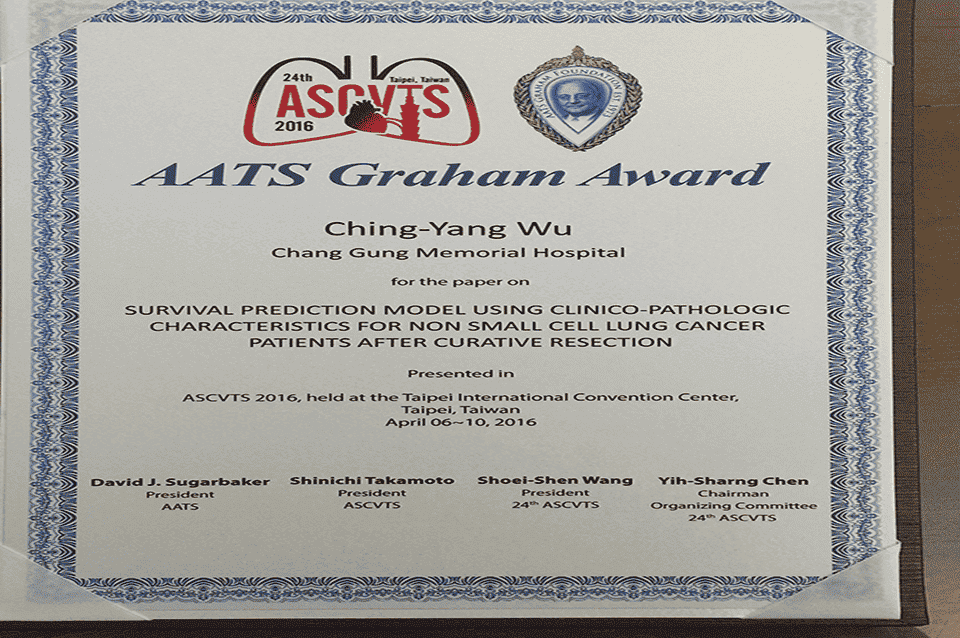
台灣血管外科學會2015智慧深耕獎
【肺癌手術研究與獲獎】2015血管外科智慧深耕獎
此篇文章為吳青陽醫師榮獲台灣血管外科學會2015智慧深耕獎的資訊分享。
【中文版】
植入式注射座對接受長期化療的癌症病患極為重要,不僅提供穩定的血管通路,亦可減少反覆穿刺所造成的血管損傷,自1982年問世以來,大大提升了病患的生活品質。然而,成功植入植入式注射座的關鍵,在於選擇合適的進入血管。主要有兩種植入技術:血管切開法與經皮穿刺法。文獻指出,血管切開法較為安全,通常目標為頭靜脈(cephalic vein),或其缺乏時,改用胸肩峰動脈的三角肌分支。若上述兩條靜脈皆不適用,才考慮使用內頸靜脈,搭配超音波導引進行穿刺。由於鎖骨下靜脈穿刺風險高(如壓迫症候群、導管斷裂、氣胸、血胸等),故在本研究中完全避免使用。為提高手術成功率並減少併發症,長庚醫療團隊於2012年建立一套標準化血管選擇流程,依據病患條件,優先使用表淺血管,再輔以內頸靜脈或下肢靜脈(如下腔靜脈走徑)作為替代方案。右側血管為優先選擇,除非病患曾接受右側乳房手術或頸部病變。
研究對象:
研究對象為2012年3月至2013年3月接受靜脈港植入的507位癌症病患,追蹤至2014年7月。手術皆在局部麻醉下完成,使用術中移動式X光機進行即時導管尖端位置確認,確保經上腔靜脈途徑置放的注射座導管尖端位於氣管岔1公分以下,經上腔靜脈途徑置放的注射座導管尖端位於下腔靜脈與右心房交界處。
主要結果如下:
- 植入成功率:100%
- 使用頭靜脈:82.4%
- 植入式注射座平均使用天數:403.8天
- 再手術比率:5.3%(27例),其中20例與導管併發症有關
- 常見併發症:感染(8例)、導管功能異常(6例)、導管移位(2例)、深層靜脈栓塞(3例)
- 手術相關併發症率由2006年1.09%降至0.4%
- 晚期併發症率由19.97%降至3.55%
與過去比較,本研究中的併發症發生率明顯下降,且未出現氣胸、血腫、導管扭曲或斷裂等問題。98%的患者在存活期間仍能正常使用靜脈港,功能喪失多與病情惡化有關而非技術問題。
討論中指出,血管切開法在經驗豐富醫師操作下安全快速,且組織創傷小。但若找不到適當血管,仍需依賴超音波導引下的穿刺技術。演算法優先選擇表淺靜脈,降低創傷與併發症風險。與過去文獻比較,研究中早期與晚期併發症明顯較低,展現標準化血管選擇置放流程的臨床效益。
結論:
本研究所建立之標準化血管選擇置放流程簡單易行,能有效降低手術併發症,並提高導管功能表現。對外科醫師、尤其是初學者具高度臨床指導價值。
文章出處
Wei, W. C., Wu, C. Y., Wu, C. F., Fu, J. Y., Su, T. W., Yu, S. Y., Kao, T. C., & Ko, P. J. (2015). The Treatment Results of a Standard Algorithm for Choosing the Best Entry Vessel for Intravenous Port Implantation. Medicine, 94(33), e1381. https://doi.org/10.1097/MD.0000000000001381
W-CW and C-YW contributed equally to this article
Correspondence: C-YW
【英文版】
Intravenous ports are essential for oncology patients undergoing long-term chemotherapy, providing secure vascular access and reducing repeated venipunctures. Since their introduction in 1982, intravenous ports have significantly improved patient quality of life. However, successful implantation requires choosing an appropriate entry vessel. Two primary techniques exist: vessel cutdown and percutaneous puncture. While the cutdown method, which targets superficial veins like the cephalic or deltoid branch of the thoracoacromial vein, is generally considered safer, some patients lack suitable superficial veins and require the puncture method. Historically, the subclavian vein was a common choice for puncture, but it carries significant risks, including pinch-off syndrome, catheter fractures, pneumothorax, and vascular injury. Consequently, the internal jugular vein—especially with echo guidance—has emerged as a safer alternative.
To optimize outcomes and minimize complications, a standard algorithm for selecting the entry vessel was developed and implemented by Chang Gung Medical Fundation in 2012. This algorithm prioritizes superficial vein exploration (cephalic and thoracoacromial veins), resorting to echo-guided internal jugular vein access only when these are unavailable. The subclavian vein was deliberately excluded due to its associated risks. In cases where upper body venous access is contraindicated (e.g., due to superior vena cava syndrome), the inferior vena cava route via the greater saphenous vein is used.
A study involving 507 oncology patients (March 2012–March 2013) who underwent IV port implantation using this algorithm was conducted, with follow-up through July 2014. Right-side vessel access was preferred to minimize catheter length and angulation, although left-side access was used when anatomical or surgical history dictated. Fuoroscopy was used intraoperatively to ensure optimal catheter tip placement. For catheters inserted via the superior vena cava, the ideal tip location is 1 cm below the carina; for those inserted via the inferior vena cava, the tip should be positioned at the junction with the right atrium."
Key Findings:
- Implantation success rate: 100%
- Cephalic vein use: 82.4% of cases
- Mean port function duration: 403.8 days
- Major reinterventions: 27 (5.3%), with 20 due to catheter-related issues
- Primary complications: infection (8), malfunction (6), migration (2), deep vein thrombosis (3)
- Procedural-related complication rate: dropped from 1.09% (in 2006) to 0.4%
- Late complication rate: reduced from 19.97% to 3.55%
Compared to prior methods, complication rates significantly declined using this algorithm. No cases of pneumothorax, hematoma, catheter kinking, or fractures were observed—largely due to the avoidance of subclavian vein puncture. The study also noted that 98% of functioning ports remained usable in patients alive at follow-up, with the decline in functionality mostly attributed to disease progression rather than technical failure.
The discussion emphasized that although both cutdown and puncture methods have merits, cutdown offers greater safety, especially in experienced hands. The use of an algorithm to guide vessel selection not only standardizes the approach but also improves outcomes. The algorithm favors veins with superficial locations and low complication risks, such as the cephalic and thoracoacromial branches, while still offering alternatives like the internal jugular vein (with ultrasound) or the greater saphenous vein when necessary.
Limitations include its observational design, though the large patient sample and real-world application strengthen the findings. The algorithm also supports training for new surgeons by offering a clear decision-making framework that accounts for anatomical variations and clinical conditions.
Conclusion:
The standard algorithm for choosing intravenous port entry vessels offers a reliable, efficient, and low-complication approach to port implantation. Its structured, evidence-based design allows consistent clinical application, improves patient safety, and is a valuable tool for surgical training and practice in oncology care.
Reference
Wei, W. C., Wu, C. Y., Wu, C. F., Fu, J. Y., Su, T. W., Yu, S. Y., Kao, T. C., & Ko, P. J. (2015). The Treatment Results of a Standard Algorithm for Choosing the Best Entry Vessel for Intravenous Port Implantation. Medicine, 94(33), e1381. https://doi.org/10.1097/MD.0000000000001381
W-CW and C-YW contributed equally to this article
Correspondence: C-YW
除了上述研究成果獲獎外,研究中的關鍵技術吳醫師亦寫相關研究闡述,雖非獲獎論文內容,但可作為理解標準化血管選擇置放流程的基礎準備,內容如下:
【中文版】
植入式注射座雖然是一個相對簡單的手術,但其相對困難之處在於找到病患自己的頭靜脈進行置放。
臨床實務上有兩種狀況可能會在術中找不到可供植入式注射座導管置放的頭靜脈,其一是約有10%病患會出現自體血管變異,包括血管缺失或是血管路徑不在胸大肌及三角肌之交界處◦
上述臨床情境的比率約10-15%,在這些臨床狀況下除非找到另外可供使用的替代血管,否則就只能使用超音波導引的內頸靜脈(穿刺處在頸部)或是鎖骨下靜脈(穿刺處在鎖骨上窩)經皮穿刺◦
然而即便是在超音波的即時影導引下進行導管置放通路的建立,將可能風險降到最低,但是仍有下的缺點。
其一是在穿刺時需要多一個額外切口才能將導管拉到鎖骨下方的注射座置放處,其二是因為有較多因手術需要的組織創傷,所以手術時間較長,術中疼痛感較大以及術後疼痛時間較長,其三是仍有一定比率氣胸或血胸的風險。
因此,如果能利用手術切口附近可以找到的自體血管,將可有效解決這一個臨床困境。
這個研究是評估經由胸肩峰靜脈三角肌分枝(thoraco-acromial vein, deltoid branch)進行植入致注射座導管置放的安全性與可行性1。
本研究納入自2012年3月至2013年11月,共有802位經由上腔靜脈途徑接受植入式注射座植入的腫瘤患者納入研究,並比較了不同進入血管的功能性結果與併發症發生率。研究顯示,大多數患者(93.6%)可以辨識出胸肩峰血管。
其中,胸肩峰靜脈的三角肌分支位於胸大肌下方的三角胸溝內側(85.8%),以及三角胸溝的深層部位(14.2%)。由於血管口徑大小與走向變化較大,我們使用了三種不同的導管植入方式,包括血管切開法(47.4%)、導絲輔助法(17.9%)、以及改良穿刺法(34.6%)。其功能性結果與併發症發生率與其他進入血管相似。
胸肩峰靜脈的三角肌分支位於頭靜脈附近。經由此血管植入靜脈輸液埠,其功能性結果與其他進入血管相似,為一項安全的替代方案。在後續研究中顯示,藉由使用胸肩峰靜脈的三角肌分支可有效地降低需要使用超音波導引經皮靜脈穿刺病患自體血管的機會,輔以管腔內置放技術,除可以完全避免病患出現氣胸以及血胸風險,即又可有效的將超音波導引經皮靜脈穿刺的比率自5%降到1%以下◦
大大提升植入式注射座的安全性以及極大程度減輕術中術後的疼痛狀況,改善病患生活品質。
1 Su, T. W., Wu, C. F., Fu, J. Y., Ko, P. J., Yu, S. Y., Kao, T. C., Hsieh, H. C., & Wu, C. Y. (2015). Deltoid branch of thoracoacromial vein: a safe alternative entry vessel for intravenous port implantation. Medicine, 94(17), e728
2 Wu, C. F., Fu, J. Y., Wen, C. T., Chiu, C. H., Hsieh, M. J., Liu, Y. H., Liu, H. P., & Wu, C. Y. (2021). Long-Term Results of a Standard Algorithm for Intravenous Port Implantation. Journal of personalized medicine, 11(5), 344. https://doi.org/10.3390/jpm11050344
【英文版】
Although implanting a intravenous port is a relatively simple procedure, the main challenge lies in locating the patient’s own cephalic vein for catheter placement. Clinically, there are two common scenarios where the cephalic vein may not be identifiable during surgery. First, approximately 10% of patients present with vascular anomalies, such as absent vessels or vascular pathways that do not lie along the typical junction of the pectoralis major and deltoid muscles. These clinical situations account for roughly 10–15% of cases. In such scenarios, unless an alternative vessel is identified, the only remaining options are ultrasound-guided percutaneous access via the internal jugular vein (with the puncture site on the neck) or the subclavian vein (with the puncture site in the supraclavicular fossa). Even with real-time ultrasound guidance—which minimizes risk—there are still several drawbacks. First, an additional incision is required to tunnel the catheter down to the injection port site beneath the clavicle. Second, due to increased tissue dissection required by the technique, the operation time is longer, and patients may experience greater intraoperative pain and prolonged postoperative discomfort. Third, there remains a non-negligible risk of pneumothorax or hemothorax. Therefore, if a native vein near the surgical incision can be identified and used, these challenges can be effectively addressed. This study evaluates the safety and feasibility of using the deltoid branch of the thoracoacromial vein for catheter placement during port implantation.1
Between March 2012 and November 2013, 802 oncology patients undergoing port implantation via the superior vena cava route were enrolled in this study. The outcomes and complication rates associated with different entry vessels were compared. The results showed that the thoracoacromial vein was identifiable in 93.6% of patients. Among them, the deltoid branch was located beneath the pectoralis major muscle within the deltopectoral groove in 85.8% of cases, and in the deeper section of the groove in 14.2%. Due to variation in vessel diameter and course, three different catheter implantation techniques were employed: vessel cutdown (47.4%), guidewire-assisted method (17.9%), and modified puncture method (34.6%). The functional outcomes and complication rates were comparable to those seen with other entry vessels.
The deltoid branch of the thoracoacromial vein is anatomically located near the cephalic vein and serves as a safe alternative for port catheter insertion, yielding similar outcomes. Follow-up studies demonstrated that use of this vessel significantly reduced the need for ultrasound-guided percutaneous vein access, thereby lowering the use of that method from 5% to below 1%.2 Moreover, combining this approach with intraluminal catheter placement techniques eliminates the risk of pneumothorax and hemothorax, and markedly reduces intraoperative and postoperative pain, ultimately enhancing patient safety and improving quality of life.
1 Su, T. W., Wu, C. F., Fu, J. Y., Ko, P. J., Yu, S. Y., Kao, T. C., Hsieh, H. C., & Wu, C. Y. (2015). Deltoid branch of thoracoacromial vein: a safe alternative entry vessel for intravenous port implantation. Medicine, 94(17), e728
2 Wu, C. F., Fu, J. Y., Wen, C. T., Chiu, C. H., Hsieh, M. J., Liu, Y. H., Liu, H. P., & Wu, C. Y. (2021). Long-Term Results of a Standard Algorithm for Intravenous Port Implantation. Journal of personalized medicine, 11(5), 344. https://doi.org/10.3390/jpm11050344