


台灣血管外科學會2015智慧深耕獎
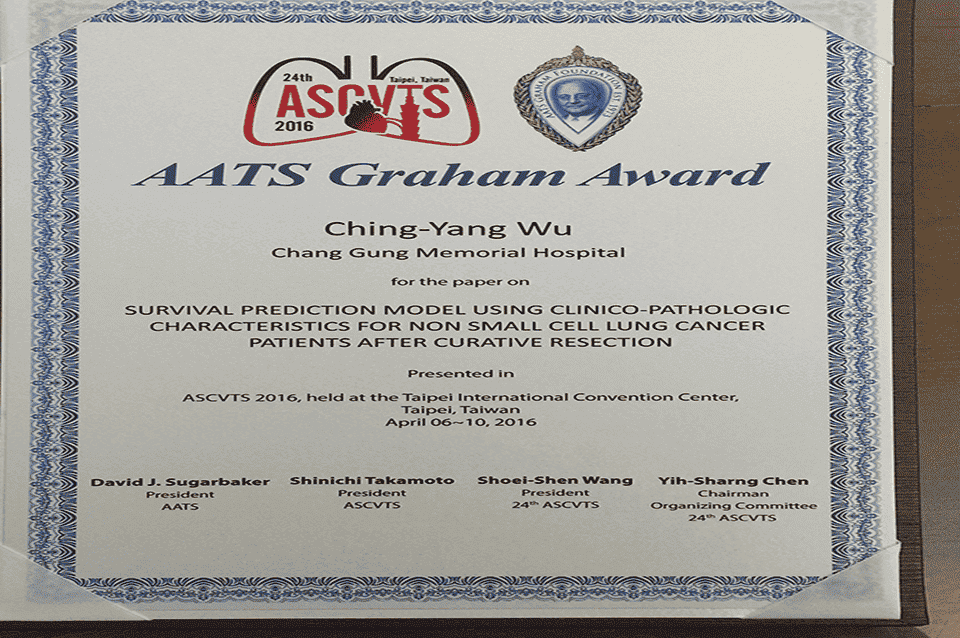
【肺癌手術研究與獲獎】美國胸腔外科學會2016 AATS Gramham award
此篇文章為吳青陽醫師榮獲美國胸腔外科學會2016 AATS Gramham award的資訊分享。
【中文版】
在可接受切除的非小細胞肺癌病患而言,考病人存活率是胸腔腫瘤治療中的關鍵議題。
其中,與存活相關最重要的議題就是如何找出會復發的病患並給予相對應的追加治療藉以降低復發風險提升病患存活率。而現有的術後追蹤指引缺乏一致性與精準性。
此外,現今對於如何辨識高風險病人、決定追蹤間隔與選擇適當影像工具仍未有共識,因此迫切需要一個整合式的預測模型。多數研究僅對特定腫瘤表現進行分析,嘗試藉由不同病理表現將特定腫瘤表現區分出不同復發風險病患;並且多未納入輔助治療的影響,亦缺乏對疾病復發的深入分析,限制了其臨床應用性。
由林口長庚醫院吳青陽醫師所發表的簡報「利用臨床與病理特徵建立非小細胞肺癌病人根除性切除手術後之存活預測模型」,提出一套具臨床實用性的存活預測工具,專為胸腔外科醫師所設計。此研究旨在彌補此臨床空白,透過風險評估模型來改善術後照護。
本研究為回溯性分析,納入2005年1月至2011年12月共609位接受手術之肺癌病人。經排除小細胞肺癌、楔形切除、切緣陽性及接受新輔助治療的個案後,共納入442位非小細胞肺癌病人,其皆接受了解剖性肺葉切除及縱膈淋巴結清除手術。
病人平均年齡為62.6歲,其中72.8%為腺癌,49.3%有臟層胸膜侵犯,平均腫瘤大小為3.25公分,而61.8%的病人未接受術後輔助治療。
研究指出影響「無病生存率(DFS)」的三項關鍵風險因子為:腫瘤大小大於5公分、有臟層胸膜侵犯,以及接受術後輔助治療。
依據這些因子建立簡單的風險評分系統:若無上述風險因子則為0分,具一項風險因子為1分,兩項為2分,三項皆有則為3分。
此評分可用於病人風險分級,進而指導個別化的術後追蹤策略。至於整體存活率(OS),則受到年齡大於60歲、腫瘤大於3公分及總轉移淋巴結比例大於0.05的影響。
針對第一期(Stage I)的病人(T1a–T2a N0 M0),本研究進一步納入吸菸史、過去惡性腫瘤病史、手術型式(非解剖性切除)、腺癌組織型、腫瘤大小、血管淋巴管侵犯及胸膜侵犯等變項,建立更精細的風險評估工具。
根據評分將病人分為低風險(0–3分)、中風險(4–7分)、高風險(8–12分)三組,提供更準確的預後評估與個別化追蹤建議。
對於第二期與第三A期的病人,因樣本數限制,分析較為有限。不過在第二A期中,血管淋巴管侵犯及N1轉移淋巴結比例為重要預測因子,而在第三A期中,神經周圍侵犯與復發顯著相關。第二B期因樣本數太少而未進行分析。
研究亦提出依風險程度制訂的追蹤計畫,包括每三個月一次的胸部電腦斷層(CT)與定期胸部X光檢查。風險因子的多寡將決定追蹤頻率與檢查密度。
整體而言,本研究提供了一個簡單實用且具臨床依據的預測模型,有助於胸腔外科醫師制定個別化術後管理計畫、早期偵測復發,並提升非小細胞肺癌病人的長期預後。
未來仍需更多研究以驗證並優化此模型,使其更廣泛應用於不同醫療環境與族群中。
【英文版】
For patients with resectable non-small cell lung cancer (NSCLC), patient survival is a key issue in thoracic oncology. Among the most critical concerns related to survival is how to accurately identify patients at risk of recurrence and provide them with appropriate adjuvant treatments to reduce recurrence and improve survival outcomes. However, current postoperative follow-up guidelines lack consistency and precision. Moreover, there is no consensus on how to identify high-risk patients, determine appropriate follow-up intervals, or select suitable imaging modalities, highlighting the urgent need for an integrated prediction model. Most existing studies analyze only specific tumor characteristics, attempting to stratify patients into different recurrence risk groups based on pathological features, but they often fail to account for the effects of adjuvant therapy and lack in-depth analysis of disease recurrence, limiting their clinical applicability.
The presentation by Dr. Ching-Yang Wu from Chang Gung Memorial Hospital in Linkou, titled “Survival Prediction Model Using Clinico-Pathologic Characteristics for Non-Small Cell Lung Cancer Patients After Curative Resection,” introduces a clinically practical survival prediction tool designed specifically for thoracic surgeons. This study aims to address the current clinical gap by developing a risk-based prediction model to enhance postoperative care for NSCLC patients. This retrospective study evaluated data from 609 lung cancer patients who underwent surgery between January 2005 and December 2011. After excluding those with small cell lung cancer, wedge resections, positive resection margins, or those who received neoadjuvant therapy, a total of 442 NSCLC patients who had undergone anatomic resection with mediastinal lymph node dissection were included. These patients had a mean age of 62.6 years, and the majority (72.8%) were diagnosed with adenocarcinoma. Visceral pleural invasion was present in 49.3% of cases, and the mean tumor size was 3.25 cm. Notably, 61.8% of patients did not receive post-operative adjuvant therapy.
The study identified several key risk factors for disease-free survival (DFS), including tumor size greater than 5 cm, visceral pleural invasion, and the receipt of post-operative adjuvant therapy. A simple scoring system was developed: patients with none of these risk factors received a score of 0; those with one, a score of 1; two factors, a score of 2; and those with all three factors, a score of 3. This scoring helped stratify patients into different risk categories for recurrence and guided follow-up care. For overall survival (OS), independent risk factors were found to be age over 60, tumor size over 3 cm, and a total metastatic lymph node ratio greater than 0.05, further refining the predictive value of the model.
A specific focus was placed on stage I patients (T1a–T2a N0 M0), where the scoring system incorporated additional variables including smoking status, prior malignancy history, type of surgical resection (with wedge resection being unfavorable), adenocarcinoma histology, tumor size, angiolymphatic invasion, and visceral pleural invasion. Based on this, patients were categorized into low-risk (scores 0–3), intermediate-risk (scores 4–7), and high-risk (scores 8–12) groups. This stratification allows for tailored surveillance and management strategies, especially since stage I disease is typically associated with better outcomes but still has variable recurrence rates depending on pathological features.
For more advanced stages (stage II and IIIa), the analysis was limited by sample size but revealed that angiolymphatic invasion and metastatic lymph node ratio were significant predictors in stage IIa, while perineural invasion was a key factor in stage IIIa. Stage IIb was not analyzed due to a small number of cases. These findings underscore the complexity of risk assessment in higher-stage disease and suggest that more granular analysis is needed in future research.
The proposed follow-up strategy includes imaging at defined intervals: chest CT scans every three months and chest X-rays at specific post-operative time points. The presence or absence of risk factors helps determine the intensity and frequency of surveillance. Overall, the study provides a practical and evidence-based model that helps thoracic surgeons individualize post-operative care, improve early detection of recurrence, and ultimately enhance survival outcomes in NSCLC patients. Future work is needed to validate the model and expand its applicability to diverse populations and clinical settings.
Reference
- Wu, C. F., Fu, J. Y., Yeh, C. J., Liu, Y. H., Hsieh, M. J., Wu, Y. C., Wu, C. Y., Tsai, Y. H., & Chou, W. C. (2015). Recurrence Risk Factors Analysis for Stage I Non-small Cell Lung Cancer. Medicine, 94(32), e1337.https://doi.org/10.1097/MD.0000000000001337
- Hsieh, C. P., Hsieh, M. J., Wu, C. F., Fu, J. Y., Liu, Y. H., Wu, Y. C., Yang, C. T., & Wu, C. Y. (2016). Prognostic factors in non-small cell lung cancer patients who received neoadjuvant therapy and curative resection. Journal of thoracic disease, 8(7), 1477–1486. https://doi.org/10.21037/jtd.2016.05.57
- Wu, C. F., Wu, C. Y., Fu, J. Y., Wang, C. W., Liu, Y. H., Hsieh, M. J., & Wu, Y. C. (2014). Prognostic value of metastatic N1 lymph node ratio and angiolymphatic invasion in patients with pathologic stage IIA non-small cell lung cancer. Medicine, 93(20), e102. https://doi.org/10.1097/MD.0000000000000102
- Wu, C. Y., Fu, J. Y., Wu, C. F., Hsieh, M. J., Liu, Y. H., Wu, Y. C., Yang, C. T., & Tsai, Y. H. (2015). Survival Prediction Model Using Clinico-Pathologic Characteristics for Nonsmall Cell Lung Cancer Patients After Curative Resection. Medicine, 94(45), e2013. https://doi.org/10.1097/MD.0000000000002013